
Organizing a large event in Cali — a concert, a fair, a corporate convention — involves dozens of providers. The cleaning one is usually the last hired and the first to be noticed when it fails. This guide summarizes how a professional cleaning operation is planned for events: schedule, shifts, waste management and common mistakes.
The schedule splits into three stages
1. Pre-event (assembly)
While booths are built and technicians wire, areas get messy fast: cardboard, plastic, construction dust, shavings. A small crew (3-6 operators depending on area) accompanies assembly collecting waste in 2-3 hour cycles. That leaves the venue ready for public entry without the assembly team having to stop and clean.
2. During the event (operation)
Here the operator profile shifts. From “trash collector” to “discrete floor presence”: restrooms always clean and stocked, rest tables clear, spills attended within 5 minutes, bins emptied before overflowing.
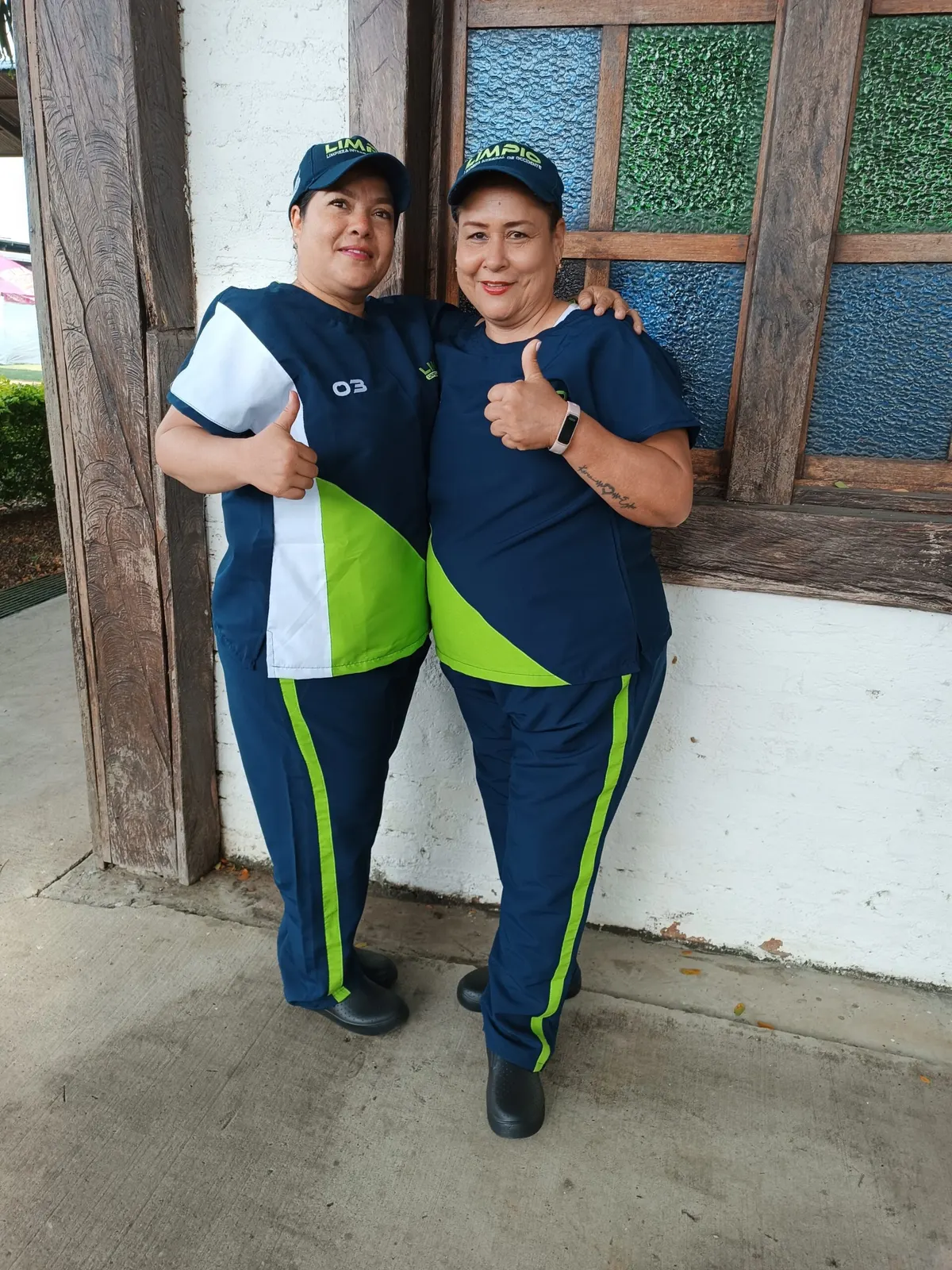
The team works 6-8 hour shifts with rotation, institutional uniform and radio or hand signals to coordinate with production.
For events over 5000 attendees the practical rule is 1 operator per 500 attendees in common areas, plus reinforcement in restrooms (1 per 4 sanitary units).
3. Post-event (disassembly)
The most underestimated phase. When the public leaves, the venue has hours (sometimes minutes) to be handed back clean to the venue administration. A larger crew enters to collect waste, separate recyclables, deep-clean floors and leave everything ready for the next event.
Underestimating post-event is the main source of financial penalties on venue rentals.
Waste management: what the client must verify
In mass events waste grows fast and diverse. If not separated at the source, it all ends up as ordinary and management cost rises. Minimum a professional operator must bring:
- Color-coded bags: green (ordinary), gray (recyclables: paper, plastic, glass), orange (organic if applicable).
- Eco-points distributed at high-traffic zones (entrances, food court, restrooms).
- Authorized manager for waste. Ask for the manager contract and manifests at the end of the event.
- For food sales: separation of organics and used cooking oil, the latter with a specialized manager.
PPE and operator kit
A uniformed operator with correct PPE is not a cosmetic detail, it’s occupational safety:
- Closed and clean institutional uniform.
- Nitrile or rubber gloves (frequent change).
- Non-slip boots.
- Mask (always at restrooms, food and high-density areas).
- Safety glasses if handling chemical spills.
For outdoor events: cap or head cover, sunscreen provided by the provider.
Coordination with production
The professional cleaning operator integrates into the event runsheet, doesn’t operate apart. That means:
- Pre-briefing with production.
- Radio or shared channel.
- Cleaning supervisor on the floor throughout the event.
- Real-time incident reporting.
If the cleaning provider doesn’t attend the briefing or doesn’t show a supervisor, you already know how the operation will go.
Common mistakes
- Subcontracting day staff without affiliation: if one gets injured, the legal problem stays with the organizer.
- Not differentiating pre/during/post: hiring the same crew for everything ends badly because the required profiles differ.
- Forgetting disassembly: always the most expensive. Negotiating disassembly separately protects the client’s budget.
- Not separating waste at source: management cost shoots up.
- Poorly sized crew: too few operators at a mass event show in restrooms and overflowing bins; too many at a small event is money wasted.
Event cleaning operator service in Cali
At Limpio Colombia we serve events in Cali and Valle del Cauca: concerts, fairs, conventions, corporate events, launches. Uniformed staff, dedicated supervision, color-coded bags, logistic coordination with production.